Automated CAD Model Analysis
Blog Post 1.01.01 - Improve Quoting Accuracy with Automated CAD Model Analysis
What is CAD Model Analysis and how can it help your company generate accurate and timely sales quotes? Read More ...
Global Edge Video Blog-1.01
Improve Quoting Accuracy with Automated CAD Model Analysis
A typical challenge faced by sheet metal fabricators, and manufacturers in general, is to produce accurate and timely sales quotes. A theme I have heard from hundreds of people over the years in the manufacturing industry – “we know if we’re making or losing money as a business, but we don’t necessarily know which accepted specific sales quotes are making or losing us money”. A primary reason for this, especially with contract manufacturers, is the time-consuming complexity of accurately analyzing incoming customer drawings and specifications.
With sheet metal parts, a potential customer will likely provide you with CAD drawings / DXF Flat Files for each sheet metal part that requires a quoted part price. To determine how much a sheet metal part will cost to fabricate is to first determine the various CAD part parameters such as: Material, Thickness, Length, Width, Perimeter, Cutout Perimeter, Hole Counts, Bend Counts, Etc. These various part parameters are generally determined with an engineer doing manual measurements, calculations and recording them on paper, in a quoting spreadsheet, or a quoting system. This is generally a labor-intensive, time-consuming process that makes it challenging to produce accurate and timely sales quotes for custom, engineered-to-order (ETO), and configure-to-order (CTO) products.
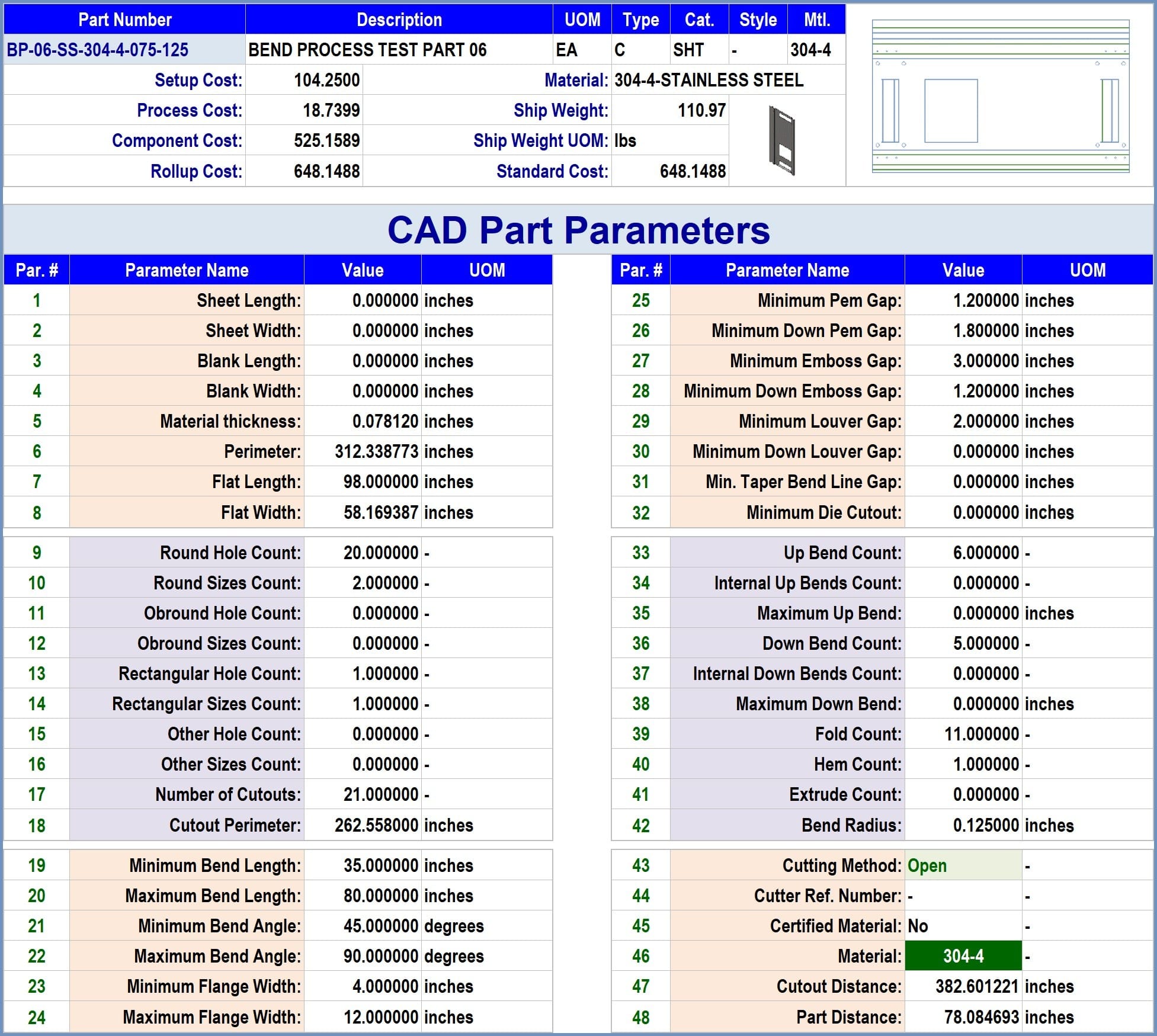
Added to this process is applying the proper time and material costs based on production size and delivery time. As the complexity of quoted items increase, it normally makes it more challenging to deliver accurate and timely sales quotes. Global Edge Engineering Assistant includes innovative software technology that can automate the labor-intensive steps associated with the quoting process. This starts with the capability to analyze sheet metal CAD parts which includes the automated extraction and importation of the following CAD part parameters:
With sheet metal parts, a potential customer will likely provide you with CAD drawings / DXF Flat Files for each sheet metal part that requires a quoted part price. To determine how much a sheet metal part will cost to fabricate is to first determine the various CAD part parameters such as: Material, Thickness, Length, Width, Perimeter, Cutout Perimeter, Hole Counts, Bend Counts, Etc. These various part parameters are generally determined with an engineer doing manual measurements, calculations and recording them on paper, in a quoting spreadsheet, or a quoting system. This is generally a labor-intensive, time-consuming process that makes it challenging to produce accurate and timely sales quotes for custom, engineered-to-order (ETO), and configure-to-order (CTO) products.
Added to this process is applying the proper time and material costs based on production size and delivery time. As the complexity of quoted items increase, it normally makes it more challenging to deliver accurate and timely sales quotes. Global Edge Engineering Assistant includes innovative software technology that can automate the labor-intensive steps associated with the quoting process. This starts with the capability to analyze sheet metal CAD parts which includes the automated extraction and importation of the following CAD part parameters:

- Material / Thickness / Part Weight / Bend Radius
- Blank / Flat (Length & Width)
- Cutouts / Holes (Count & Size)
- Minimum / Maximum Bend Length
- Minimum / Maximum Bend Angle
- Minimum / Maximum Flange Width
- Minimum Pem Hole to Bend Line Gap
- Minimum Embossment to Bend Line Gap
- Minimum Louver to Bend Line Gap
- Maximum Up / Maximum Down Bend
- Fold / Hem / Extrude Counts
- Minimum Taper / Die Cut to Bend Line Gap
These CAD part parameters lay the foundation to generate accurate and timely sales quotes by eliminating the need for an engineer to manually analyze sheet metal CAD parts. Additionally, the CAD part parameters provide the foundation for “Manufacturability Testing” functionality provided by Global Edge Engineering Assistant that can make sure a sheet metal part can be successfully fabricated based on the Standard Bend Processes provided by your company.
The next step with Global Edge Engineering Assistant to simplify and automate the quoting process is the capability to generate optimal routings based on the CAD part parameters. Built-in to Global Edge Engineering Assistant is a powerful “Configuration Engine” that generates optimal routing steps based on cost and/or delivery time. This is accomplished with the capabilities of the Configuration Engine that automatically calculates turret press or laser cut times based on material type and thickness based on the CAD part parameters which also includes sheet metal bend times including complete routing steps for each part automatically processed. This includes the following sample results:

Global Edge Engineering Assistant includes an optional connection to your ERP system that can provide the Configuration Engine with the latest process and material costs that are automatically rolled up into the part cost as illustrated in the above diagram. Global Edge Engineering Assistant also includes functionality that can supply your existing quoting system with the automatically generated time and material cost rollups. This is accomplished with a configurable ERP Interface that translates and maps this data directly to your ERP system or generates an XML file that can be imported by many quoting systems. Additionally, if your company utilizes a quoting spreadsheet to calculate and generate sales quotes, Global Edge Engineering Assistant includes spreadsheet integration capabilities that can automatically supply your quoting spreadsheet with the latest cost rollups if that is your preferred method of generating sales quotes.
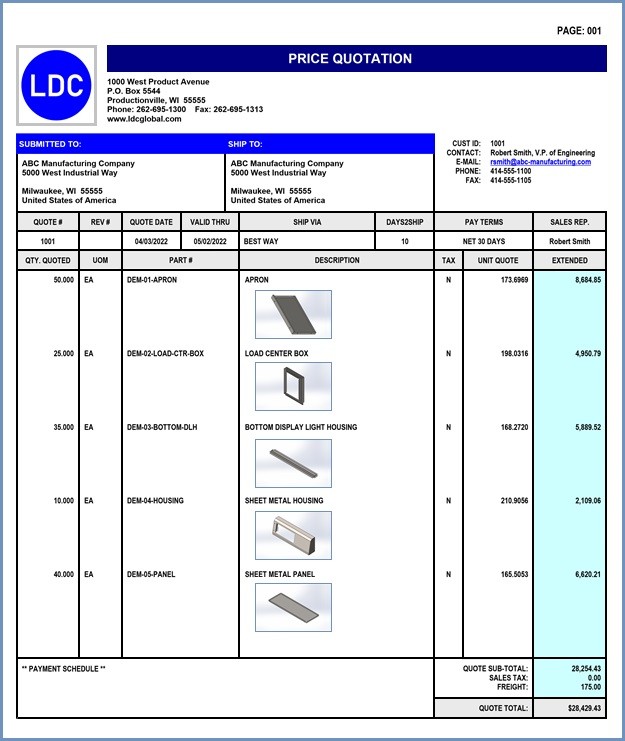
Global Edge Engineering Assistant can also provide complete sales quote generation capabilities for companies that want to replace their existing quoting capabilities or stick with a combined approach as explained above. The following is an example of a sales quote generated with Global Edge Engineering Assistant:
CAD Model Analysis: Transforming Sales Quoting in Manufacturing
How Automated Model Analysis Drives Accuracy and Efficiency for Sheet Metal Fabricators
Introduction
For many sheet metal fabricators and manufacturers, the process of generating accurate and timely sales quotes remains a stubborn challenge. While most businesses track overall profitability, it is surprisingly common for manufacturers to lack visibility into which individual sales quotes contribute positively or negatively to their bottom line. This disconnect often stems from the complexity and labor-intensive nature of analyzing customer-provided drawings and specifications—a process that can be riddled with manual tasks, interpretation errors, and time delays.
What is CAD Model Analysis?
CAD Model Analysis refers to the systematic review and interrogation of three-dimensional Computer-Aided Design (CAD) files, which encapsulate all the geometric information about a part or assembly. For manufacturers, especially those working in sheet metal, these models contain critical details—dimensions, tolerances, material types, and complex features—that must be understood to accurately estimate costs, assess manufacturability, and generate sales quotes.
Traditionally, this analysis was done manually by engineers who would pore over 2D drawings and 3D models, often using physical measurement tools or laboriously annotating digital files. Today, advances in digital manufacturing and automation allow for software-driven CAD Model Analysis, transforming raw model data into actionable pricing, labor estimates, and even production instructions.
Why is CAD Model Analysis Important for Sales Quoting?
When a manufacturer receives a request for quote (RFQ), the CAD model serves as the foundation for estimating:
- Material requirements: Calculating the volume, area, or weight of sheet metal needed.
- Manufacturing complexity: Identifying bends, holes, cutouts, and other features that drive machine time and labor cost.
- Tolerance and quality requirements: Understanding which features require tight tolerances or special processes.
- Assembly and finishing processes: Flagging operations such as welding, painting, or powder coating.
Without precise model analysis, quotes risk being inaccurate—either padded with unnecessary margins that lose competitive advantage, or underestimated, which can erode profitability.
The Challenges of Manual Quoting
Many manufacturers still rely on skilled estimators who manually interpret CAD files and drawings. Common challenges include:
- Time-consuming reviews: Parsing complex models and drawings by hand can take hours, especially for intricate parts or assemblies.
- Human error: Details can be missed or misunderstood, leading to costly mistakes in quoting and production.
- Inconsistent evaluation: Different estimators may interpret requirements differently, resulting in quote variability and risk.
- Limited throughput: The manual process limits the number of quotes a company can process, leaving potential revenue on the table.
- Automated CAD Model Analysis: A Solution for Accurate and Timely Quotes
Modern software tools are now capable of importing customer CAD files and automatically analyzing them for key features. Here’s how automated CAD Model Analysis transforms quoting:
- Feature recognition: Software algorithms can instantly identify bends, flanges, hole patterns, embosses, and other critical geometry in sheet metal parts.
- Material calculations: The system can derive blank sizes, nesting layouts, and calculate scrap rates—key for material cost estimation.
- Process simulation: Advanced tools can simulate manufacturing steps, flagging potential issues before a quote is issued and suggesting optimal process routes.
- Cost breakdowns: Automated analysis ties geometric features to machine time, labor steps, and finishing operations, generating detailed cost estimates.
- Integration with ERP and quoting systems: Analysis outputs can feed directly into quoting software or enterprise resource planning tools, streamlining workflow from RFQ to quote delivery.
By automating these steps, manufacturers can dramatically reduce quote turnaround time, minimize errors, and achieve far greater consistency.
Business Benefits of CAD Model Analysis
The adoption of automated CAD Model Analysis offers several key advantages:
- Speed: Automating the review process allows sales and engineering teams to respond to RFQs in minutes or hours rather than days.
- Accuracy: Detailed, consistent model interrogation reduces the risk of underquoting or missed manufacturing steps, protecting profitability.
- Transparency: By documenting how each quote is generated, manufacturers can trace profitability at the quote level—identifying which jobs deliver margin and which do not.
- Scalability: Higher throughput means businesses can quote more jobs, pursue more opportunities, and grow revenue without increasing headcount.
- Customer confidence: Fast and accurate quoting builds trust with customers, differentiating the company in a competitive marketplace.
Addressing the Visibility Gap in Manufacturing Profitability
As noted, many manufacturers know their overall profit but lack clarity on which specific orders are making or losing money. Automated CAD Model Analysis directly addresses this gap by providing:
- Granular traceability: Every quote can be linked to its originating model, process assumptions, and cost breakdowns, enabling post-job reviews.
- Continuous improvement: By analyzing quote-level outcomes, businesses can refine their estimation models, pricing strategies, and process flows over time.
This level of visibility turns quoting from a “best guess” into a repeatable, data-driven process.
Practical Implementation Considerations
Adopting CAD Model Analysis requires some planning:
- Software selection: Evaluate solutions that support your file formats (e.g., SolidWorks, AutoCAD, Inventor) and integrate with your quoting workflow.
- Training and change management: Teams must learn to trust and interpret automated outputs—initial reviews may still require human oversight.
- Data consistency: Standardizing part and feature naming, and ensuring customer models are well-defined, improves analysis results.
- Integration: The greatest value comes from linking model analysis directly to quoting and ERP systems for seamless workflow.
Conclusion
CAD Model Analysis is revolutionizing the way manufacturers approach sales quoting, shifting the process from art to science. By leveraging automated tools to decode customer models, companies ensure rapid, accurate, and profitable quotes—empowering sales teams, pleasing customers, and driving sustainable business growth. For sheet metal fabricators, in particular, CAD Model Analysis promises to close the loop between quoting and profitability, providing the actionable insight needed to stay competitive in today’s fast-moving market.