Manufacturability Testing (Design For Manufacturing)
Blog Post 1.02.03 - Test Successful Fabrication of Parts Before They Leave Engineering
Utilize Manufacturability Testing to determine that parts can be successfully fabricated. Read More ...

Global Edge Video Blog-1.02

Test Succesful Fabrication of Parts Before They Leave Engineering
A challenge for many manufacturing operations, especially for sheet metal fabricators, is to successfully fabricate a sheet metal part the first time it’s attempted on the shop floor. As engineering comes up with new part designs, there are several factors that come into play for successful sheet metal part fabrication that includes:

Material
- Proper Material Type
- Proper Material Thickness
- Proper Material Finish
Bending Machine Tool Capabilities
- Part within Allowable Tooling Limits
- Bend Angles within Allowable Limits
- Part within Bend Tonnage Limit
- Part Flange Size within Minimum and Maximum Limits
- Internal Bends with Height Limits
Hole / Embossment / Louver / Special Features Locations
- Pem Hole Distance from Bend Line
- Embossment / Louver Distance from Bend Line
- Special Feature Interference with Flange
Hardware Specifications
- Proper Matching Hardware
These are many of the factors can add to the complexity of the successful design and fabrication of a sheet metal part. The approach of Global Edge Engineering Assistant is the capability to perform a “Manufacturability Test” to determine if the sheet metal part passes or fails the criteria with the above factors. As part of the Manufacturability Test process, Global Edge Engineering Assistant starts with the automated analysis of a sheet metal CAD part to import and record the following CAD part parameters:
- Material / Thickness / Part Weight / Bend Radius
- Blank / Flat (Length & Width)
- Cutouts / Holes (Count & Size)
- Minimum / Maximum Bend Length
- Minimum / Maximum Bend Angle
- Minimum / Maximum Flange Width
- Minimum Pem Hole to Bend Line Gap
- Minimum Embossment to Bend Line Gap
- Minimum Louver to Bend Line Gap
- Maximum Up / Maximum Down Bend
- Fold / Hem / Extrude Counts
- Minimum Taper / Die Cut to Bend Line Gap
These CAD part parameters are subsequently stored in the Global Edge database to serve as a foundation for a “Manufacturability Testing” process. The CAD part parameters include identification up and down bends counts, location of Pem Hole and Louver distance from a bend line, including cutout counts and cutout perimeters, etc.
Sample CAD Part Parameters
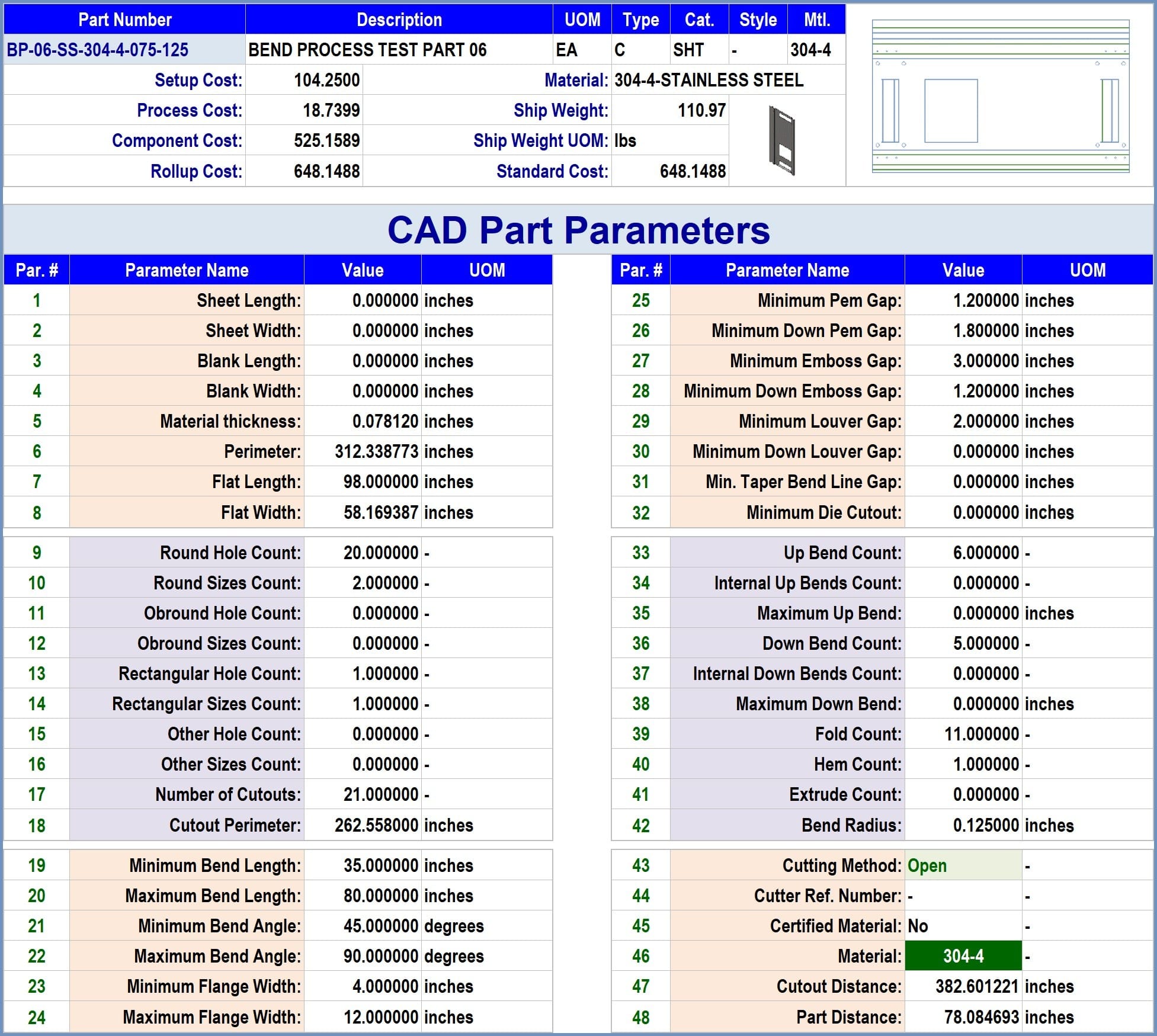
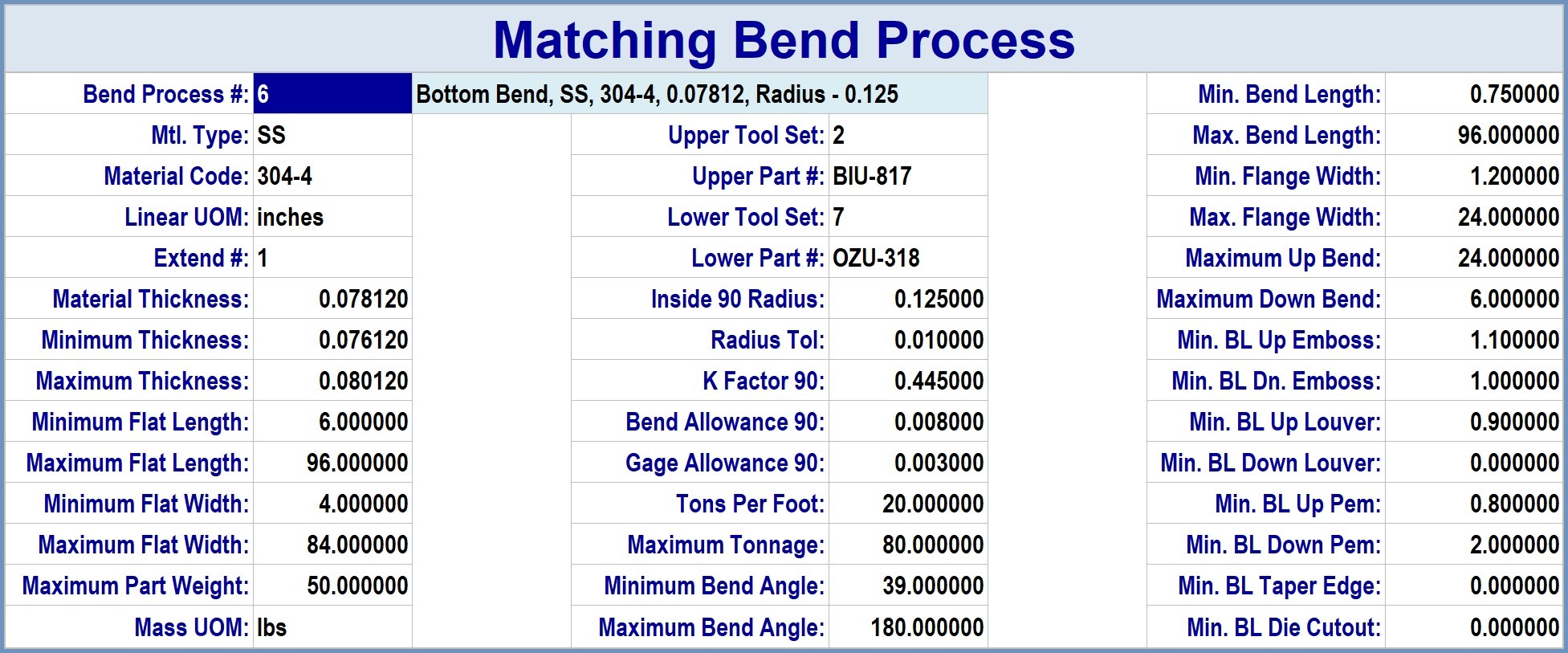
As part of the CAD part analysis, Global Edge Engineering Assistant automatically identifies and matches the sheet metal part with the proper user definable Bend Processes as illustrated with the following Sample Bend Process:
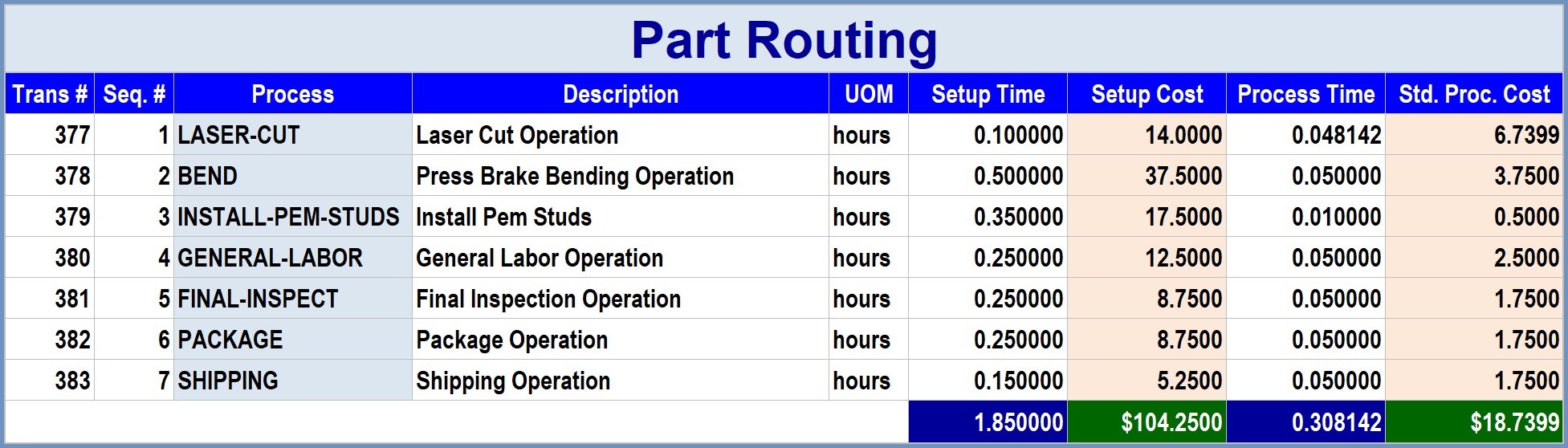
As Global Edge Engineering Assistant completes the importation and storage of the CAD part parameters, the software automatically generates routings based on those parameters:
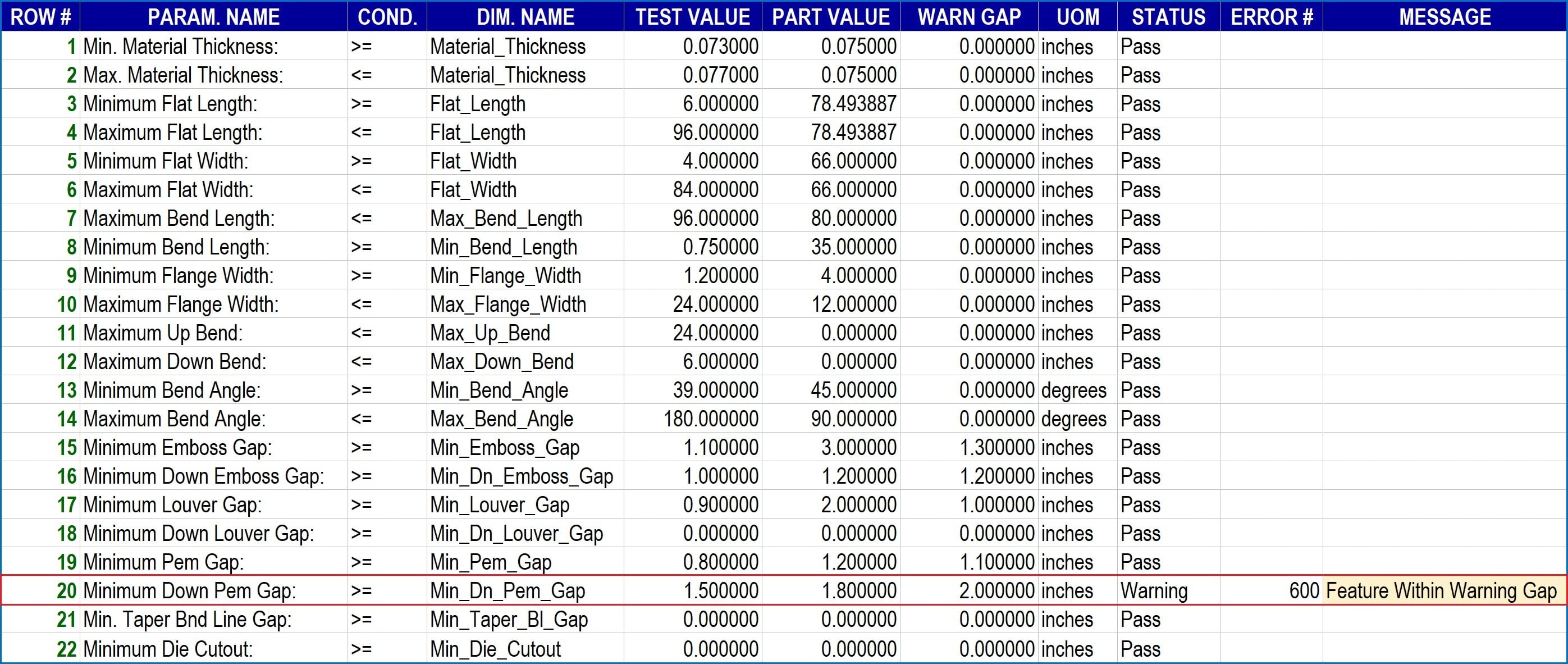
During the generation of the routings, Global Edge Engineering Assistant automatically determines if the sheet metal part can be successfully fabricated with each of the routing steps. For example, with the “Press Brake Bending Operation”, the software automatically determines whether the sheet metal part can be successfully bent comparing the CAD Part Parameters with the matching Bend Process. This includes the automatic execution of a “Manufacturability Test” that allows the engineer to view the test results:
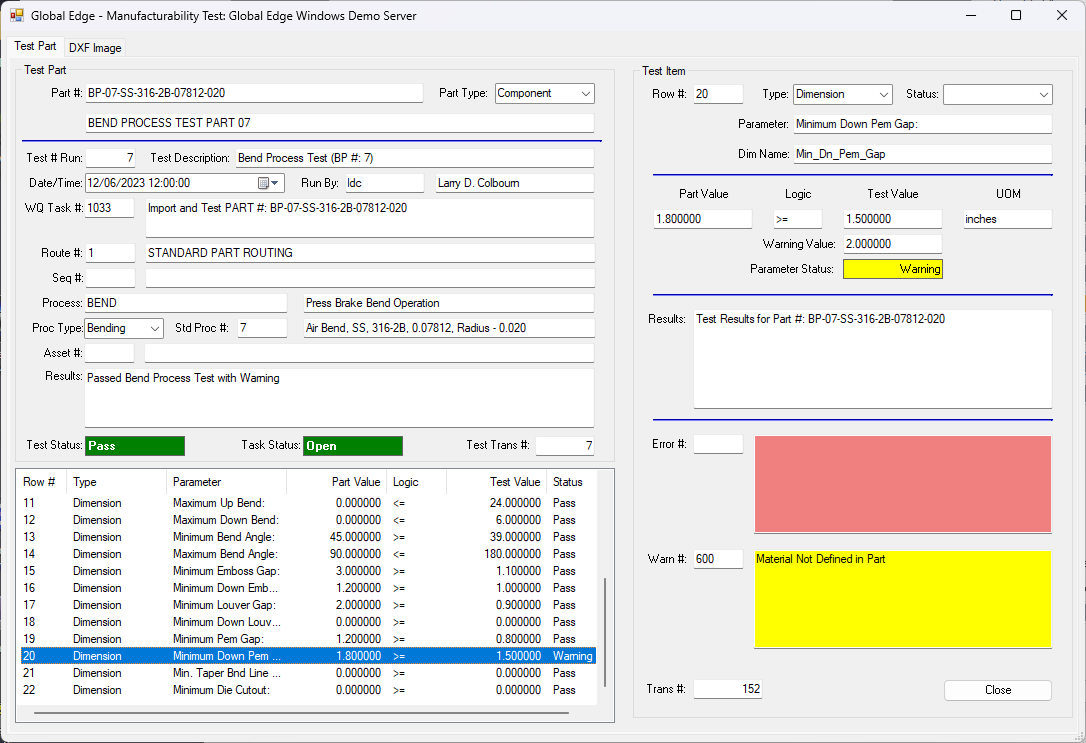
The above and below example includes 22 tests that were performed on the selected part. The highlighted test below (Minimum Down Pem Gap) detected a warning that “Feature Within Warning Gap”. The matching Bend Process for the sheet metal part requires the Minimum Down Pem Gap is at least 1.500000 inches from the nearest bend line. The detected gap with the selected sheet metal part is 1.800000 inches, which indicates the gap is allowable. However, a Warning Message is detected because ideally with the matching Bend Process indicates that the Minimum Down Pem Gap should ideally be at least 2.000000 inches.
When a manufacturability test fails one or more tests, the engineer can make the appropriate change(s) to the necessary 3D CAD Sheet Metal Model and repeat the Manufacturability Test until the errors are corrected. Global Edge Engineering Assistant provides an innovative software tool that helps speed up the whole prototyping process and eliminates shop floor rework by getting things right the first time before a part reaches the shop floor.
Ensuring Successful Fabrication of Parts Before Leaving Engineering: The Role of Manufacturability Testing
Comprehensive Strategies for Sheet Metal Fabrication Success
In the constantly evolving landscape of manufacturing, one enduring challenge is the reliable transition of part designs from engineering to the shop floor—especially for sheet metal fabricators. Too often, unforeseen issues emerge when a part is fabricated for the first time, resulting in costly delays, wasted material, and frustration across the production team. To mitigate these risks and ensure a seamless handoff, it is essential to implement rigorous manufacturability testing that evaluates every aspect of a part’s design before it leaves engineering. This practice not only validates that parts can be successfully fabricated, but also optimizes for quality, efficiency, and cost-effectiveness.
The Criticality of Manufacturability Testing
Manufacturability testing serves as a gatekeeper between the engineering and production stages. Its purpose is twofold: to identify and resolve design issues that might hinder fabrication, and to confirm that all specifications align with the capabilities and limitations of available machinery and materials. By systematically evaluating parts for manufacturability, organizations minimize the risk of first-run failures and maximize the efficiency of their manufacturing operations.
For sheet metal fabricators, where tolerances are tight and complexity is common, manufacturability testing is especially vital. It acts as a structured checklist, scrutinizing every major factor that could influence whether a part can be produced as intended.
Material Selection: Foundation of Success
The selection of appropriate materials is fundamental to successful sheet metal part fabrication. Manufacturability testing examines several aspects of material choice:
- Proper Material Type: The engineering team must designate a material that is compatible with the manufacturing process and the end-use environment. For example, certain alloys may be better suited for corrosion resistance, while others offer superior formability.
- Proper Material Thickness: Tolerances in thickness must fall within the operational range of the shop’s machinery. Undersized or oversized material could lead to tool damage or sub-standard parts.
- Proper Material Finish: The initial finish of the material can impact secondary operations such as painting, plating, or anodizing. Manufacturability testing verifies that the chosen material finish supports all downstream processes.
Bending Machine Tool Capabilities
A major source of fabrication challenges arises from incompatibility between part designs and the capabilities of bending machines. Manufacturability testing should rigorously assess the following:
- Part Within Allowable Tooling Limits: Each bending machine has physical limits, including maximum and minimum part size, that must be respected.
- Bend Angles Within Allowable Limits: Certain machines can only produce bends within specific angular ranges. Attempting bends outside these parameters may result in incomplete or inaccurate bends.
- Part Within Bend Tonnage Limit: The force required to bend the material must not exceed the machine’s tonnage capacity. Manufacturability testing simulates or calculates the required force for every bend.
- Part Flange Size Within Minimum and Maximum Limits: Flanges that are too small may not be formable, while excessively large flanges may interfere with tooling.
- Internal Bends with Height Limits: The design must respect minimum and maximum bend heights as dictated by the tools and dies in use.
By carefully assessing these criteria, engineering teams can ensure that their designs are not only theoretically sound but also practically achievable on the shop floor.
Hole, Embossment, Louver, and Special Feature Placement
Modern sheet metal parts often incorporate a variety of features—such as holes, embossments, and louvers—that improve utility but complicate manufacturing. Manufacturability testing scrutinizes the placement and interaction of these features:
- Pem Hole Distance from Bend Line: Holes for attaching hardware must be placed a minimum distance from bends to avoid distortion during forming and to accommodate hardware installation tools.
- Embossment / Louver Distance from Bend Line: Embossments or louvers too close to a bend can cause material warping or incomplete formation.
- Special Feature Interference with Flange: Features must be positioned to avoid interference with flanges or other part characteristics. Manufacturability testing uses digital simulations and physical mockups to verify clearances.
Even small miscalculations in feature placement can render a part impossible to fabricate or assemble, leading to significant rework.
Hardware Specifications: Ensuring Compatibility
Many sheet metal parts require additional hardware such as fasteners, inserts, or threaded studs. Manufacturability testing must confirm:
- Proper Matching Hardware: The specified hardware must be compatible with the material type, thickness, and any applied finishes. Incompatible hardware can lead to installation failures or part rejection.
Testing also verifies that installation tools are available and that there is adequate room for proper installation without damaging the part or surrounding features.
Implementation of Manufacturability Testing in Practice
The value of manufacturability testing is only realized when it is woven into the engineering process as a standard operating procedure. This involves a blend of digital and physical methodologies:
- Design for Manufacturability (DFM) Software: Advanced CAD software can analyze part models for manufacturability, flagging potential issues such as insufficient clearances, excessive bend radii, or incompatible hardware.
- Cross-Functional Design Reviews: Engaging manufacturing, quality, and tooling experts in design reviews ensures that practical shop floor realities are considered.
- Prototyping and Pilot Runs: Building prototypes or conducting small pilot runs of new parts prior to full-scale production can uncover unforeseen fabrication challenges.
The Benefits of Early Manufacturability Testing
Investing time and effort in manufacturability testing before parts leave engineering offers numerous tangible benefits:
- Reduced Scrap and Rework: By catching errors early, manufacturers minimize wasted material and avoid costly production delays.
- Improved Production Efficiency: Shop floor personnel can fabricate parts confidently and quickly, knowing that designs have been vetted for manufacturability.
- Higher Product Quality: Consistent adherence to best practices yields parts that meet or exceed specifications, reducing the risk of defects and customer dissatisfaction.
- Lower Overall Costs: Although manufacturability testing requires an up-front investment, it is offset by reduced waste, fewer engineering change orders, and faster time-to-market.
Continuous Improvement: Feedback Loop from Shop Floor to Engineering
Manufacturability testing is most effective when paired with a robust feedback loop. Shop floor technicians and operators should be encouraged to report any issues encountered during fabrication to engineering. This ongoing communication helps refine design guidelines and manufacturability criteria, ensuring that future designs are even more reliable.
Conclusion
Successfully fabricating parts the first time they are attempted on the shop floor is not a matter of luck but of deliberate, systematic preparation. By employing comprehensive manufacturability testing, engineering teams can ensure that only robust, feasible designs make their way to production. This proactive approach is essential for maintaining competitiveness, customer satisfaction, and operational excellence in the fast-paced world of sheet metal fabrication.
Ultimately, manufacturability testing is not just a technical checkpoint—it's a strategic advantage, transforming potential obstacles into opportunities for continuous improvement and lasting success.