Automated Production Work Queue
Blog Post 2.01.02 - Manufacturability Testing on Daily Production Runs
Automate the testing of daily production runs to ensure successful part fabrication. Read More ...

Global Edge Video Blog-2.01

Manufacturability Testing on Daily Production Runs
Global Edge Engineering Assistant provides the capability to automatically test small to large batches of sheet metal parts to identify potential fabrication errors before they leave engineering. This includes a complete CAD Part Parameter analysis of each sheet metal part and an automatic comparison with the matching bending machine tool process. This process can save your company significant time, money and effort with the following test results:

- Pem Holes Too Close to Bend Line
- Maximum Bend Tonnage Greater Than Bend Process Allows
- Part Too Big for Bend Process
- Bend Angle Exceeds Maximum Allowed
- Embossment Too Close to Bend Line
- Bend Line Length Shorter than Minimum Allowed
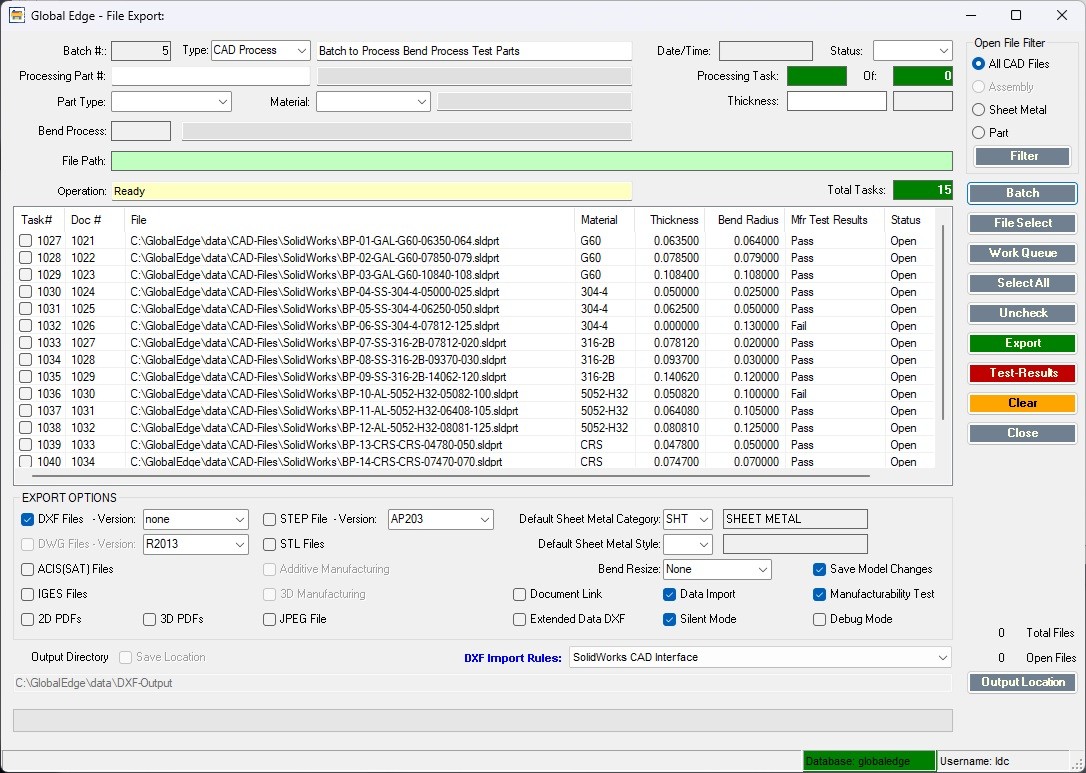
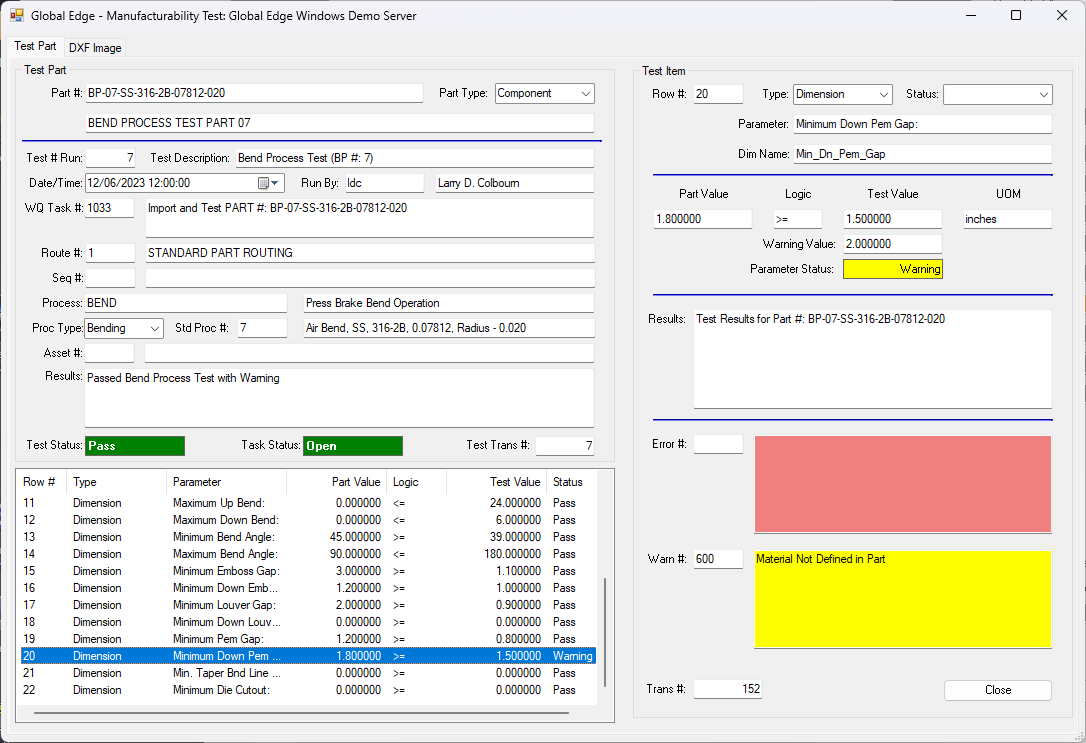
Automated Manufacturability Testing for Daily Production Runs
Enhancing Sheet Metal Fabrication with Global Edge Engineering Assistant
Introduction
In today’s competitive manufacturing landscape, ensuring the manufacturability of each part before it enters the production floor is essential to maintaining high quality, reducing waste, and optimizing throughput. Traditional manufacturability testing, often performed manually or after design finalization, can be time-consuming, error-prone, and costly when issues are discovered late in the process. As production volumes increase and part complexity grows, the risks associated with undetected manufacturability issues can have severe impacts on both timelines and budgets.
Automated manufacturability testing on daily production runs represents a transformative approach for modern manufacturers, particularly in industries relying heavily on sheet metal fabrication. This document explores how Global Edge Engineering Assistant leverages automation to test batches of parts—ranging from small prototype runs to large-scale production—ensuring potential fabrication errors are identified and corrected before they leave the engineering stage.
The Need for Automated Manufacturability Testing
Manufacturability issues, if left undetected, can lead to a host of downstream problems, including machine downtime, scrap, re-work, missed delivery deadlines, and customer dissatisfaction. Manual checks are often insufficient when it comes to high-volume, high-mix manufacturing environments, where hundreds or thousands of unique components are engineered and released daily.
Key challenges addressed by automated manufacturability testing include:
- The increasing complexity of part geometries and assemblies.
- The tight integration of design and production schedules, leaving little room for redesign.
- Shorter lead times demanded by customers.
- The need to minimize human error and standardize testing criteria across projects and shifts.
By embedding manufacturability checks directly into the engineering process, manufacturers can identify and resolve issues early, reducing the risk of costly surprises on the shop floor.
Global Edge Engineering Assistant: Redefining Manufacturability Testing
Global Edge Engineering Assistant is an advanced toolset designed to automate the manufacturability testing process for sheet metal parts. This platform integrates seamlessly with CAD systems, utilizing intelligent algorithms to perform a full analysis of each part’s parameters. It then compares these parameters with the capabilities and constraints of available bending machines, ensuring that every part released for fabrication can be successfully manufactured.
Key features of Global Edge Engineering Assistant include:
- Automatic batch analysis for small-to-large production runs, supporting both high-mix and high-volume operations.
- Direct integration with CAD files, extracting critical part parameters without manual data entry.
- Automatic cross-referencing of part geometry with bending machine tool libraries, including tonnage, bend radius, and machine dimensions.
- Comprehensive reporting and flagging of manufacturability violations, with actionable feedback for engineers.
Comprehensive CAD Part Parameter Analysis
At the heart of automated manufacturability testing lies the intelligent analysis of CAD part parameters. Global Edge Engineering Assistant scrutinizes every detail of the CAD model, including hole placements, bend lines, angles, part dimensions, and feature proximity. This allows for the detection of subtle yet critical manufacturability issues that could otherwise be overlooked.
The system evaluates:
- Hole locations relative to bend lines and part edges.
- Bend angles and radii relative to machine capacity.
- Overall part size compared to available equipment.
- Embossments, cutouts, and other special features in the context of fabrication constraints.
This level of detailed, automated analysis ensures that each design is not only theoretically sound but also practically manufacturable on the shop floor.
Automatic Comparison with Bending Machine Tool Processes
A unique capability of Global Edge Engineering Assistant is its automatic comparison of part parameters with the actual bend machine tooling and process limitations. For every sheet metal part, the system checks:
- Available tooling configurations.
- Maximum and minimum allowable bend angles and radii.
- Bend sequence feasibility and potential for collision or interference.
- Machine tonnage and maximum part dimensions.
This ensures that the part can be fabricated on the intended machine without retooling or manual adjustments, reducing bottlenecks and unplanned downtime.
Critical Manufacturability Tests and Results
The automated system conducts a series of targeted tests to flag common and costly manufacturability pitfalls, each of which can have major implications for production efficiency and product quality. Below are examples of critical checks performed:
Pem Holes Too Close to Bend Line
If a PEM (self-clinching fastener) hole is located too near a bend line, it can cause deformation or cracking during the bending process. The system automatically measures the distance from each PEM hole to the nearest bend and flags any violation of minimum distance requirements, allowing the engineer to reposition the hole or adjust the bend.
Maximum Bend Tonnage Greater Than Bend Process Allows
Each bending machine has a maximum tonnage limit it can apply during fabrication. The Assistant calculates the required tonnage for each bend based on material type, thickness, and bend length, comparing it to the machine’s rated capacity. Parts exceeding the limit are flagged, preventing potential machine overload and ensuring operator safety.
Part Too Big for Bend Process
Oversized parts that do not fit within the machine working envelope or that exceed back-gauge travel are identified automatically. This prevents the costly scenario of starting a job only to discover that the part cannot be produced on the available machines.
Bend Angle Exceeds Maximum Allowed
Certain geometries require bend angles that are outside the capabilities of the machine or tooling. The system checks each bend against maximum and minimum allowed angles, flagging any noncompliance and enabling swift design modification.
Embossment Too Close to Bend Line
Embossed features near bends can lead to distortion or incomplete formation during fabrication. Global Edge Engineering Assistant verifies that all embossments are located a safe distance from bend lines, based on machine and tool specifications.
Bend Line Length Shorter than Minimum Allowed
Very short bend lines may be unachievable with standard tooling, leading to incomplete bends or material tearing. The system calculates all bend line lengths and flags those below the allowed threshold, ensuring consistent quality and minimizing rework.
Business Impact: Time, Cost, and Efficiency Gains
Automating manufacturability checks on daily production runs delivers tangible business benefits:
- Time Savings: Automated analysis is performed in seconds to minutes, enabling rapid iteration and reducing the overall engineering cycle time.
- Cost Reduction: Early detection of issues reduces scrap, rework, and wasted labor, directly impacting the bottom line.
- Improved Quality: Standardized testing and reporting reduce variability and human error, leading to consistently high-quality output.
- Higher Throughput: By eliminating bottlenecks at the manufacturing stage, production can flow more smoothly with fewer interruptions.
Integration into the Engineering Workflow
Global Edge Engineering Assistant is designed to fit into existing engineering and production workflows with minimal disruption. Automated checks can be triggered at key milestones—such as design release, ECO submission, or daily batch processing—ensuring manufacturability validation is built into every step. Reports and flagged issues are clearly communicated to engineers, enabling rapid resolution and learning.
Scalability and Customization
Whether managing daily prototype batches or high-volume production runs, the system scales to meet demand. Custom rules and thresholds can be configured to match unique process requirements, material types, or customer specifications, adding flexibility alongside robust testing.
Conclusion
Automating manufacturability testing on daily production runs has become a necessity for leading-edge manufacturers. By leveraging tools such as Global Edge Engineering Assistant, organizations can ensure only manufacturable parts leave engineering, minimizing scrap and rework, optimizing production, and delivering consistent quality to customers. The result is a leaner, more resilient operation—capable of meeting the challenges of modern manufacturing with confidence and efficiency.