Automated Production Work Queue
Blog Post 9.01.02 - Ensure Engineering Tasks are Completed On-Time
Make sure your engineering workflow tasks are completed on-time with an Automated Production Work Queue. Read More ...

Global Edge Video Blog-9.01

Ensure Engineering Tasks are Completed On-Time
Global Edge Engineering Assistant is an innovative engineering tool that automates many of the labor-intensive workflow tasks associated with preparing information for the shop floor. This starts with the automated generation of DXF Flat Files from SolidWorks Sheet Metal CAD Models including the incorporation of extended data to facilitate Automated CAM Bend Program Generation. This also includes Manufacturability Testing to determine if sheet metal parts can be successfully fabricated before leaving engineering.
This also includes an Automated Production Work Queue that integrates daily ERP production orders with engineering to automate Manufacturing Engineering process.
This also includes an Automated Production Work Queue that integrates daily ERP production orders with engineering to automate Manufacturing Engineering process.

- Automates Manufacturing Engineering Workflow Process
- Provides Shop Floor with Accurate and Timely Information
- Helps Reduce and Eliminate Shop Floor Rework
- Increases Engineering Capacity without Adding Additional Staff
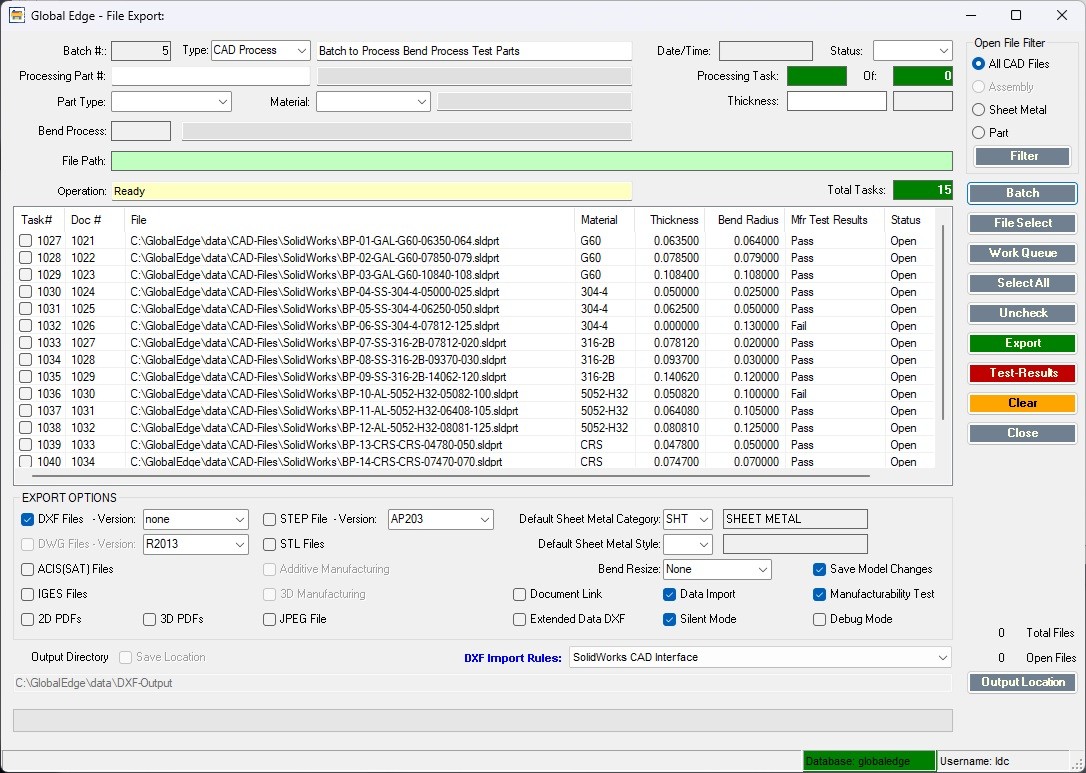
Ensuring On-Time Completion of Engineering Tasks with an Automated Production Work Queue
Leveraging Automation for Efficient Manufacturing Engineering Workflows
Introduction
Timely execution and delivery of engineering tasks is fundamental to the success of any manufacturing operation. In today’s competitive environment, delays in engineering workflows can cascade throughout a production facility, resulting in missed deadlines, increased costs, excessive rework, and diminished customer satisfaction. The engineering department is often the linchpin in this process, responsible for translating complex designs into actionable shop floor instructions and production schedules. As manufacturers seek to streamline operations and boost efficiency, automation has emerged as a transformative force—particularly in the context of production work queues.
Global Edge Engineering Assistant exemplifies this innovation, providing a sophisticated solution for automating many labor-intensive aspects of manufacturing engineering. By integrating design software, manufacturability testing, and ERP production orders into a seamless and automated workflow, this tool ensures that engineering tasks are completed on-time and with a high degree of accuracy. In this document, we explore the capabilities and benefits of an Automated Production Work Queue, and how it can revolutionize engineering workflows for manufacturers.
The Challenge: Timely Completion of Engineering Tasks
Manufacturing engineering is rife with complexities. Teams are tasked with preparing information for the shop floor, interpreting CAD models, generating programming data for fabrication, and validating manufacturability—all while juggling daily production orders and responding to unexpected challenges. Traditional engineering workflows can be labor-intensive and prone to errors, especially when manual intervention is required at multiple stages. Common challenges include:
- Manual Preparation of Shop Floor Data: Engineering teams must translate design files into formats suitable for production, often requiring repetitive tasks such as generating DXF files or compiling detailed specifications.
- Data Discrepancies and Delays: Information may be incomplete, inconsistent, or delivered to the shop floor late, leading to confusion and costly rework.
- Limited Engineering Capacity: The volume of tasks may exceed available resources, especially as production scales, forcing teams to prioritize urgent orders at the expense of routine tasks.
- Manufacturability Issues: Parts may be designed in ways that are difficult or impossible to fabricate, but these issues are often discovered only after production has commenced.
- ERP Integration Challenges: Coordinating engineering output with daily enterprise resource planning (ERP) production orders is critical, but can be cumbersome without automation.
Addressing these issues requires more than incremental improvements—it demands a systematic transformation in how engineering workflows are managed and executed.
The Solution: Automated Production Work Queue
Global Edge Engineering Assistant is designed to tackle these challenges head-on, replacing manual, error-prone workflows with a sophisticated automated system. At the heart of this solution is the Automated Production Work Queue, which dynamically integrates manufacturing engineering with daily ERP production orders.Automated Generation of DXF Flat Files.
One of the most labor-intensive tasks in manufacturing engineering is the preparation of flat pattern files from 3D CAD models—particularly in sheet metal fabrication. Global Edge Engineering Assistant automates the generation of DXF flat files from SolidWorks Sheet Metal CAD Models. This automation is not limited to simple file creation; it extends to the incorporation of enhanced metadata, which supports downstream activities such as automated CAM bend program generation. This ensures that shop floor instructions are not only precise but also tailored to the capabilities of the production equipment.
- Seamless CAD Integration: Engineering teams can work directly within their preferred CAD environment, with automated routines extracting all necessary data for manufacturing.
- Extended Data for CAM Automation: Metadata such as bend lines, tooling requirements, and material specifications are embedded within the DXF files, streamlining the creation of CAM programs for bending operations.
- Error Reduction: Automation minimizes the risk of human error, ensuring that files are generated accurately and consistently every time.
Manufacturability Testing
Before a part leaves the engineering department and enters production, it is essential to validate that it can be fabricated successfully. Manufacturability testing is integrated directly into the automated workflow, scanning CAD models for potential issues such as excessive bend radii, unsupported features, or material incompatibilities. This proactive approach:
- Helps engineers identify and correct design issues before they reach the shop floor
- Reduces instances of rework and scrapped parts
- Ensures that only manufacturable designs are released to production, enhancing overall efficiency
ERP Integration and Automated Workflow Management
The Automated Production Work Queue bridges the gap between engineering and production scheduling by tightly integrating with daily ERP production orders. This integration has several profound benefits:
- Real-Time Synchronization: Engineering tasks are aligned with live production data, ensuring that information is prepared and delivered in accordance with actual shop floor needs.
- Prioritization of Tasks: The system automatically prioritizes urgent or high-impact tasks, allowing engineering resources to be allocated where they are needed most.
- Work Queue Transparency: Engineers and production managers have full visibility into the status of engineering tasks, with automated alerts and progress tracking.
Key Benefits of Automated Production Work Queues
Implementing an Automated Production Work Queue with Global Edge Engineering Assistant delivers a suite of important benefits:
- Automation of Manufacturing Engineering Processes: Routine and repetitive tasks are handled automatically, freeing engineers to focus on innovation and problem-solving.
- Accurate and Timely Shop Floor Information: Automation ensures that the shop floor receives complete, correct, and up-to-date information, minimizing delays and confusion.
- Reduction and Elimination of Shop Floor Rework: By validating manufacturability and automating file generation, errors are caught early, and rework is greatly reduced or eliminated altogether.
- Increased Engineering Capacity: Engineers can handle a larger volume of work without the need for additional staff, supporting business growth and scalability.
- Enhanced Collaboration: With engineering and production teams working from a unified, automated queue, communication improves and bottlenecks are reduced.
Implementing Automated Workflows: Best Practices
To maximize the benefits of an automated production work queue, manufacturers should consider several best practices:
- Invest in Training: Ensure engineering teams are well-versed in the use of automated tools and understand how their workflows integrate with production scheduling.
- Maintain Data Integrity: Standardize CAD model practices and ensure that all necessary metadata is included for automation. Regularly review and update templates and conventions.
- Continuous Improvement: Monitor engineering and production KPIs to identify opportunities for further workflow optimization. Solicit feedback from users and shop floor personnel to refine automation routines.
- Scalable Solutions: Select tools and platforms that can grow with your business, supporting increased production volume and complexity over time.
Case Study: Transforming Engineering Workflows with Automation
Consider a mid-sized sheet metal manufacturer who implemented Global Edge Engineering Assistant. Before automation, engineering staff spent hours each day manually preparing flat pattern files, cross-referencing production schedules, and troubleshooting manufacturability issues that often resulted in delayed orders and costly rework.After deploying the Automated Production Work Queue:
- The time required for DXF file preparation dropped by over 70%.
- Shop floor rework was reduced by 50%, thanks to integrated manufacturability testing.
- Engineering throughput increased, allowing the company to take on additional production orders without hiring new staff.
- Customer satisfaction improved, with more accurate delivery timelines and fewer errors in fabricated parts.
Conclusion
Ensuring that engineering tasks are completed on-time is no longer an insurmountable challenge. Global Edge Engineering Assistant, with its Automated Production Work Queue and integrated manufacturability testing, offers manufacturers a powerful means to automate, streamline, and optimize their engineering workflows. By bridging the gap between design, engineering, and production, manufacturers can increase capacity, reduce errors, eliminate rework, and meet production schedules with confidence. The future of manufacturing engineering is automated, and those who embrace these innovations will be well-positioned for success.