Manufacturability Testing
Blog Post 9.03.02 - Reduce Shop Floor Errors with Manufacturability Testing
Detect shop floor errors with your part designs before they reach the shop floor utilizing Manufacturability Testing. Read More ...

Global Edge Video Blog-9.03

Reduce Shop Floor Errors with Manufacturability Testing
Global Edge Engineering Assistant provides innovative software technology that allows you to automatically perform a Manufacturability Test on sheet metal CAD parts. This is accomplished with software functionality that performs a complete part parameter analysis on a sheet metal part and stores this information in the Global Edge database.
The CAD Part Parameters are then automatically compared with bending machine tool parameters to determine if a sheet metal part can be successfully fabricated. The CAD Part Parameters analyzed include the following:
The CAD Part Parameters are then automatically compared with bending machine tool parameters to determine if a sheet metal part can be successfully fabricated. The CAD Part Parameters analyzed include the following:
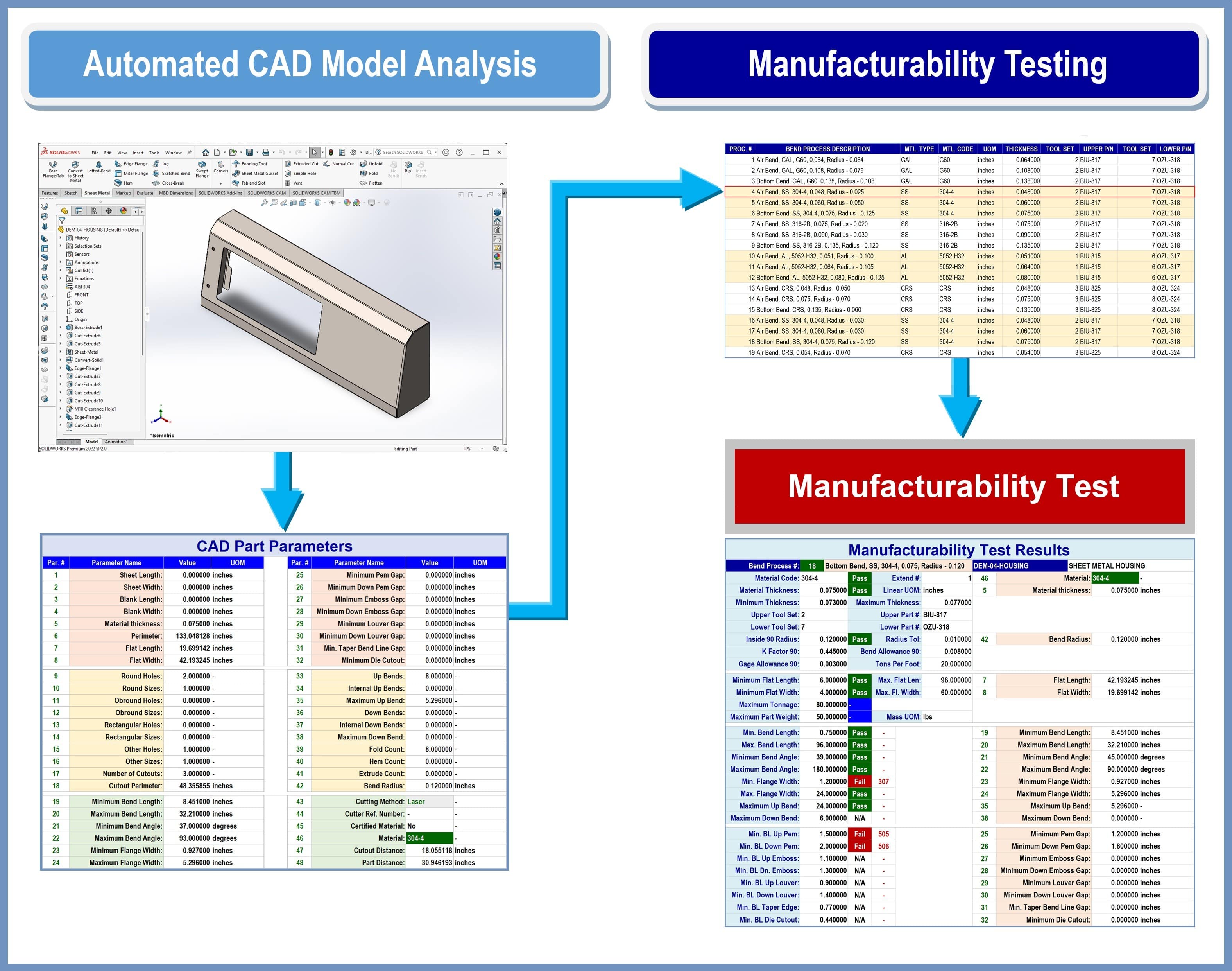
- Material / Thickness / Part Weight / Bend Radius
- Blank / Flat (Length & Width)
- Cutouts / Holes (Count & Size)
- Minimum / Maximum Bend Length
- Minimum / Maximum Bend Angle
- Minimum / Maximum Flange Width
- Minimum Pem Hole to Bend Line Gap
- Minimum Embossment to Bend Line Gap
- Minimum Louver to Bend Line Gap
- Maximum Up / Maximum Down Bend
- Fold / Hem / Extrude Counts
- Minimum Taper / Die Cut to Bend Line Gap
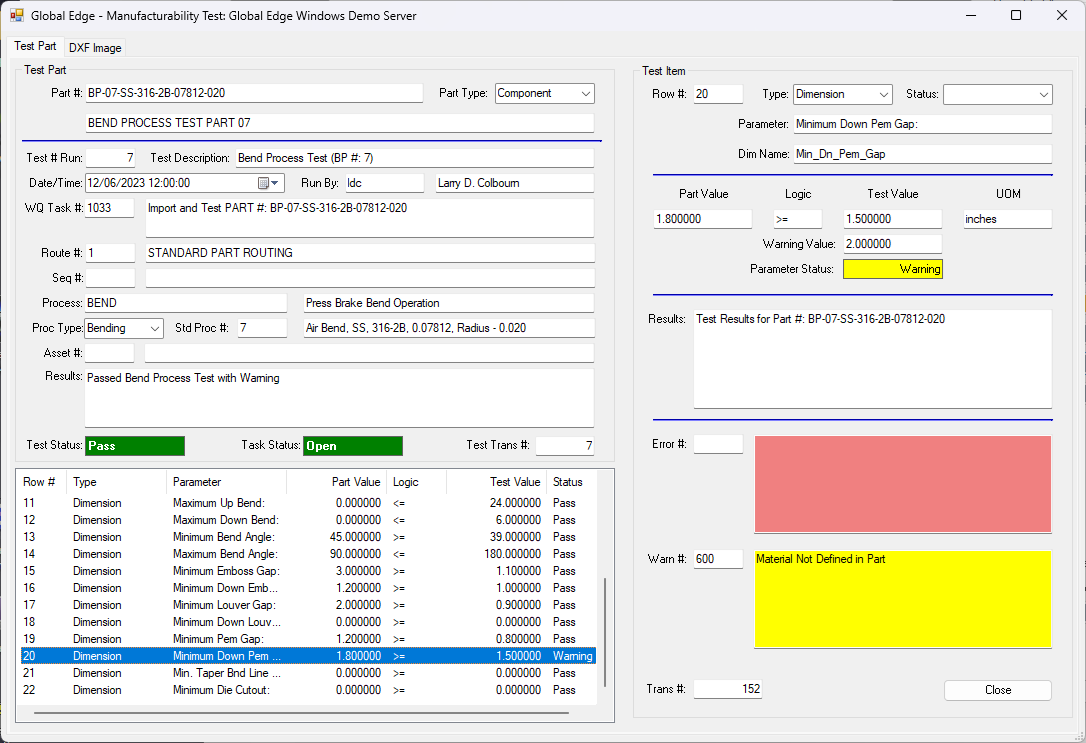
Reducing Shop Floor Errors with Manufacturability Testing
Leveraging Advanced Software to Ensure Precision and Efficiency in Sheet Metal Fabrication
In the rapidly evolving landscape of modern manufacturing, the pressure to deliver high-quality products within tight timelines is unrelenting. One of the most persistent challenges faced by manufacturers, particularly those working with sheet metal components, is the occurrence of errors on the shop floor. These errors can lead to costly delays, wasted materials, and even compromised safety standards. However, with the advent of Manufacturability Testing and intelligent engineering solutions, it has become possible to preemptively identify and eliminate potential errors before a part ever reaches the shop floor.
The Genesis of Shop Floor Errors
Shop floor errors can manifest in many forms—incorrect bends, incompatible material thickness, ill-placed cutouts, and poor alignment between design intent and machine capabilities. These mistakes often originate in the design phase, where even minor miscalculations or oversights can propagate through the production process, culminating in significant production issues.Traditional methods of error detection typically involve manual reviews or post-production inspections, both of which are time-consuming and reactive rather than preventive. In high-velocity manufacturing environments, such methods are insufficient. What is needed is a proactive approach that systematically scrutinizes digital part designs for manufacturability issues before physical production commences.
Introducing Manufacturability Testing
Manufacturability Testing provides a comprehensive solution to the problem of shop floor errors. At its core, this approach leverages advanced software algorithms to conduct a thorough analysis of sheet metal CAD parts. By evaluating a wide array of part parameters and juxtaposing them with the operational constraints of the available bending machinery, Manufacturability Testing enables engineers and designers to pinpoint potential manufacturability issues early in the design process.The Global Edge Engineering Assistant, for example, represents a new generation of innovative software technology tailored for this purpose. With its automated testing capabilities, it dramatically increases the likelihood that only compatible, error-free parts proceed to fabrication.
Automated Part Parameter Analysis
Manufacturability Testing begins with a complete parameter analysis of the digital part model. The software dissects each design, extracting and cataloging a multitude of part characteristics:
- Material: The software recognizes the specified material type, ensuring compatibility with bending and forming equipment.
- Thickness: Material thickness is checked against machine tolerances to prevent failed bends or deformations.
- Part Weight: By calculating part weight, the system ensures that handling and processing will not exceed equipment or operator capacity.
- Bend Radius: The bend radius is compared with tooling limitations to verify that bends can be performed without cracking or excessive spring back.
- Blank / Flat Dimensions: The software assesses the length and width of unformed blanks, confirming they fit within the working envelope of the machines.
- Cutouts / Holes: Counts and sizes of cutouts and holes are analyzed to avoid causing weaknesses in the part or interfering with subsequent bends.
- Minimum / Maximum Bend Length: Ensures all bends are feasible within the available dies and press brake capabilities.
- Minimum / Maximum Bend Angle: Identifies whether specified bend angles are achievable with the tools and processes at hand.
- Minimum / Maximum Flange Width: Confirms that flanges are neither too narrow (risking instability) nor too wide (exceeding tooling limits).
- Gaps to Bend Lines: The distances between features such as Pem holes, embossments, louvers, tapers, and die cuts to bend lines are verified to prevent interference and ensure proper forming.
- Maximum Up/Down Bends: The number and direction of bends are tallied to guarantee they do not exceed machine capacity or complicate part extraction.
- Fold / Hem / Extrude Counts: The overall complexity of the part is evaluated to anticipate manufacturing difficulties.
All these parameters are systematically stored in the Global Edge database, creating a digital repository that can be referenced for future designs and process improvements.
Comparative Analysis with Machine Tool Parameters
Once part parameters are captured, the software automatically compares each value to the corresponding bending machine tool parameters. This comparative analysis is crucial; it moves beyond theoretical design and asks the practical question: “Can this part actually be fabricated with the available resources?”
If discrepancies are detected—such as a bend radius that exceeds tooling capability or flange widths incompatible with the press brake—the system flags these issues immediately. Designers are then empowered to adjust their models directly, streamlining the iteration process and virtually eliminating the risk of costly shop floor surprises.
Benefits of Proactive Manufacturability Testing
The advantages of integrating Manufacturability Testing into the product development lifecycle are far-reaching:
- Reduced Scrap and Rework: By catching errors early, manufacturers minimize the material waste and time lost to correcting flawed parts.
- Accelerated Production Timelines: Fewer interruptions on the shop floor allow for smoother, faster workflows, helping companies meet deadlines reliably.
- Increased First-Time Yield: More parts are fabricated correctly on the first attempt, enhancing overall efficiency and customer satisfaction.
- Data-Driven Improvement: The accumulation of parameter data supports ongoing process optimization and equipment upgrades.
- Greater Collaboration: Engineers and machine operators can communicate more effectively, guided by objective, data-backed insights.
- Enhanced Compliance and Safety: Automatic checks on part weight, dimensions, and feature placement help ensure adherence to safety standards and industry regulations.
Common Sources of Shop Floor Errors Addressed
Manufacturability Testing specifically targets several of the most common sources of shop floor errors in sheet metal fabrication:
- Bend Line Interference: Incorrect placement of features too close to bend lines, which may cause deformation or breakage during forming.
- Material Incompatibility: Selecting materials or thicknesses that are difficult or impossible to process with current equipment.
- Tooling Limitations: Failing to account for the physical limitations of dies, punches, and press brakes when designing bends and flanges.
- Complexity Overload: Unnecessarily intricate parts that tax machine capabilities or complicate assembly.
By systematically reviewing these factors, the likelihood of encountering design-induced shop floor errors drops dramatically.
Integrating Manufacturability Testing into Engineering Workflows
To maximize the value of Manufacturability Testing, it should be seamlessly integrated into the existing CAD-to-manufacturing pipeline. This involves:
- Incorporating Manufacturability Analysis as a required step in the design sign-off process.
- Training design engineers to interpret Manufacturability Test results and iterate efficiently.
- Creating closed feedback loops so production insights update design rules and software parameters for continuous improvement.
Modern software tools, such as those provided by Global Edge Engineering Assistant, are designed with these integration needs in mind, facilitating straightforward adoption and rapid return on investment.
The Future of Manufacturability Testing
As manufacturing becomes increasingly digitized and interconnected, the role of automated manufacturability analysis will only grow. Artificial intelligence and machine learning will further enhance parameter analysis, offering predictive insights and adaptive solutions that account for machine wear, material batch variations, and evolving design standards.
In the near future, we can expect manufacturability testing to become standard practice, not only in sheet metal work but across a wide array of manufacturing disciplines. This proactive approach will empower companies to maintain the highest standards of quality, efficiency, and safety—securing their competitive edge in a demanding global marketplace.
Conclusion
Shop floor errors are not an unavoidable fact of life in manufacturing—they are a challenge to be met with innovative, data-driven solutions. Manufacturability Testing stands at the forefront of this effort, giving engineers the tools to detect and resolve design issues long before a part is ever physically produced. By harnessing the power of automated parameter analysis and intelligent comparative checks, manufacturers can ensure that every step from design to delivery is as smooth, precise, and error-free as possible.
Adopting Manufacturability Testing today is an investment in tomorrow’s operational excellence—a commitment to precision, efficiency, and sustained success in the age of digital manufacturing.